
Book a consultation

The solved cases: where Ayurveda became pharmacology

Most of Ayurveda is still being translated. This page covers the part that already has been: compounds where a 3,000-year-old use and a modern mechanism now describe the same molecule. We include one entry that failed replication, on purpose. A translation project with no failures is not being honest about its method.
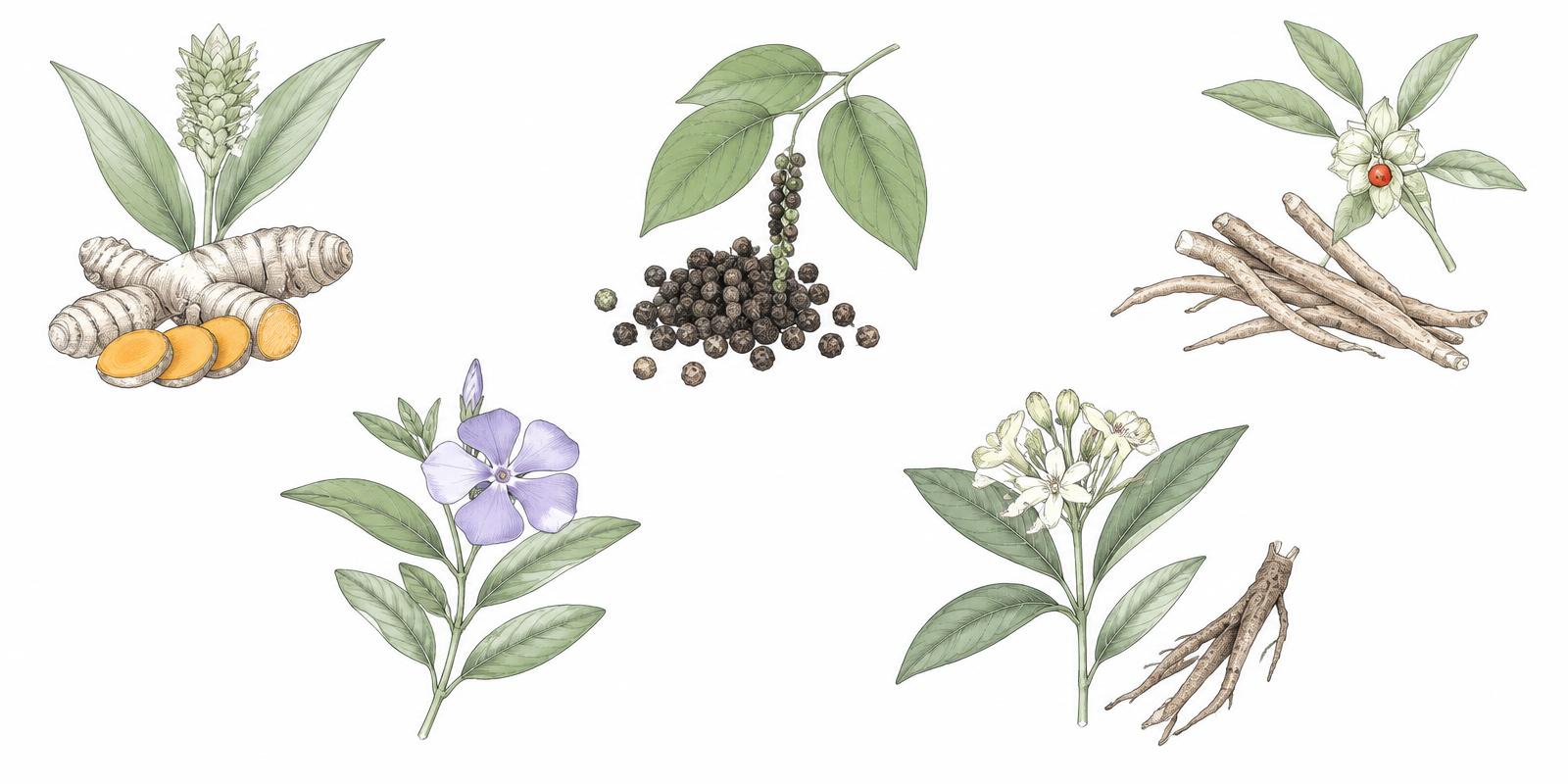
Botanical drawings of turmeric, black pepper, ashwagandha, periwinkle and sarpagandha

Four tiers, eleven cases

Every case carries one tier. The chart shows how the eleven entries divide.

3Pharmacologically Solved5RCT / Meta-Analysis Validated2Single RCT / Limited N1Acknowledged Gap

● Pharmacologically Solved

Active compound isolated, mechanism characterized, now a regulated drug or claim.

● RCT / Meta-Analysis Validated

Multiple randomized trials or a pooled meta-analysis, consistent direction of effect.

● Single RCT / Limited N

Real trial data, but a small sample or not yet replicated.

▲ Acknowledged Gap

Trialed rigorously, and the traditional claim did not hold up.

01
Sarpagandha

Rauwolfia serpentina → Reserpine

Pharmacologically Solved
Traditional use
Used in classical Ayurveda for insomnia, agitation and "insanity", and for snakebite.
What modern science found
Reserpine was isolated in 1952 (Ciba). It irreversibly blocks VMAT2, the vesicular monoamine transporter, depleting presynaptic norepinephrine, dopamine and serotonin.
Clinical outcome
One of the first modern antihypertensives and antipsychotics. Used for decades, then largely replaced by drugs with fewer depressive side effects.
Biohacking relevance
Not a biohack. A cautionary anchor. It shows mechanism isolation works, and it is why "natural means no CNS side effects" is false: reserpine can cause clinical depression at therapeutic doses. Validated is not the same as risk-free.
02
Sadabahar

Catharanthus roseus → Vincristine & Vinblastine

Pharmacologically Solved
Traditional use
Periwinkle, used in Ayurvedic and regional folk medicine for diabetes.
What modern science found
Screening for an oral antidiabetic effect (never confirmed) turned up potent anti-leukemic activity instead. The vinca alkaloids bind tubulin and block microtubule polymerization, arresting cells in mitosis.
Clinical outcome
Vincristine and vinblastine are WHO Essential Medicines, first-line today in pediatric acute lymphoblastic leukemia and Hodgkin lymphoma.
Biohacking relevance
The clearest proof that an Ayurvedic plant can yield a frontline drug. A credibility case, not a wellness protocol.
03
Haridra

Curcuma longa + Piperine → Curcumin

RCT / Meta-Analysis Validated
Traditional use
Used for inflammation, wound healing and joint pain, and paired with black pepper centuries before anyone knew why.
The mechanism behind the pairing
Shoba et al., Planta Medica 1998: piperine raised curcumin bioavailability by 154% in rats and 2000% in human volunteers, by inhibiting glucuronidation and P-glycoprotein efflux.
Clinical outcome
A 2021 meta-analysis in Complementary Therapies in Medicine pooled 11 RCTs and 1,258 knee osteoarthritis patients. Curcuminoids beat comparators on VAS and WOMAC pain scores, with no dose-response difference between ≥1000 mg/day and lower doses, and fewer adverse events than NSAIDs.
Protocol rule
Never supplement curcumin without piperine or a lipidated or phytosome formulation. Without it, you are taking a near-inert compound.
04
Kapikacchu

Mucuna pruriens → Natural L-DOPA

Single RCT / Limited N
Traditional use
A Rasayana (rejuvenative) herb for tremor and vitality.
What modern science found
Mucuna seeds naturally contain levodopa, the dopamine precursor used in Parkinson's treatment.
Clinical outcome
Katzenschlager et al., J Neurol Neurosurg Psychiatry 2004;75(12):1672–1677. Double-blind crossover trial in 8 Parkinson's patients: 30 g mucuna gave faster onset (34.6 vs 68.5 min, p=0.021), 110% higher peak plasma levodopa and 21.9% longer "on" time than levodopa/carbidopa.
Biohacking relevance
Striking data, but n=8 and never replicated at scale. This is a prescription question for diagnosed patients and sits outside a wellness platform. Evidence of mechanism only. Do not self-administer.
05
Ashwagandha

Withania somnifera → Cortisol & stress reactivity

RCT / Meta-Analysis Validated
Traditional use
The signature Rasayana adaptogen for vitality and resilience to stress.
Clinical outcome
Chandrasekhar, Kapoor & Anishetty, Indian J Psychol Med, Jan 2012. Randomized, double-blind, placebo-controlled: standardized root extract 300 mg twice daily for 60 days in adults with chronic stress lowered serum cortisol and validated stress scores versus placebo.
Protocol application
One of the most defensible daily entries: standardized root-extract dosing, a named biomarker (cortisol) and a fixed 60-day window you can mirror.
06
Methi

Trigonella foenum-graecum → Glycemic control

RCT / Meta-Analysis Validated
Traditional use
A classical food-medicine for prameha, conditions resembling diabetes.
Clinical outcome
Several recent meta-analyses of RCTs in type 2 diabetes and prediabetes show fenugreek lowers fasting glucose and HbA1c as an adjunct to standard therapy.
Protocol application
Adjunct only, for metabolic-phenotype users. Always alongside, never instead of, prescribed glucose-lowering therapy.
07
Shallaki

Boswellia serrata → Joint inflammation

RCT / Meta-Analysis Validated · with an honest caveat
Traditional use
An anti-inflammatory resin for joint and connective-tissue complaints.
Clinical outcome
A 2020 meta-analysis found Boswellia extracts reduced osteoarthritis pain versus placebo. The Cochrane review CD002947 points the same way but rates evidence quality low to moderate, citing small trials and industry funding.
Protocol application
Pairs with curcumin and piperine in an anti-inflammatory stack. The Cochrane caveat stays visible. Do not round this up.
08
Brahmi

Bacopa monnieri → Cognitive performance

RCT / Meta-Analysis Validated
Traditional use
A Medhya Rasayana, the classical cognition herb.
Clinical outcome
Pase et al., J Altern Complement Med 2012, systematic review of RCTs: chronic dosing over weeks to months consistently improved delayed free recall. No reliable effect on working memory or reaction time.
Protocol application
A fair nootropic entry. Effects take weeks and are specific to memory consolidation. It is not an acute stimulant.
09
Isabgol

Plantago ovata → Cholesterol

Pharmacologically Solved · regulatory-grade
Traditional use
A classical bulk laxative and gut-soothing fiber.
Clinical outcome
Psyllium soluble fiber has carried an FDA-approved health claim since 1998 for reducing coronary heart disease risk through LDL lowering, backed by a large RCT and meta-analysis base.
Protocol application
The highest-confidence, lowest-risk entry. Boring but bulletproof, and the one to show a skeptical physician.
10
Gurmar

Gymnema sylvestre → Adjunct glycemic support

Single RCT / Limited N
Traditional use
"Sugar destroyer", chewed to blunt sweet taste.
Clinical outcome
Registered trials and older controlled studies show glucose lowering in type 2 diabetes, including a comparison against metformin. Gymnemic acids blocking glucose absorption and sweet receptors is plausible. Beta-cell regeneration remains unproven.
Protocol application
Promising but early. Pair with fenugreek and flag the beta-cell claim as unproven.
11
Guggulu

Commiphora mukul → Cholesterol

Acknowledged Gap
Traditional use
A classical lipid-lowering resin, still one of the most cited "Ayurvedic statin" claims.
What the rigorous trial found
Szapary et al., Arch Intern Med 2003: in a randomized, placebo-controlled trial, guggulipid did not lower LDL cholesterol, and the higher dose was linked to a modest LDL increase.
Clinical outcome
The traditional claim did not hold up under a controlled trial in a Western population.
Why it stays on the page
This is our test of honesty. Citing guggulu as solved while leaving out this trial would be marketing, not science. A skeptical scientist will look for it first.

Knowing what works is half of it. The other half is how to use it safely.

See the process